A buyer in Rotterdam signs off a charming brown puppy plush sample in March. By June, a pre-shipment inspection has flagged three things: no small-parts warning on the stuffing bag, a needle classified as a sharp point for a six-year-old target age, and an instruction sheet written for adults rather than children.
That gap between a nice sample and a shippable product is where DIY craft kit programs lose money. So the conclusion first: a custom DIY animal kit for boys is not a plush toy with a needle dropped in the box. It is three products in one - a sewn character shell, an assembly component set, and a documentation and packaging package - and the packaging line, not the soft toy, usually decides whether the container clears customs and the retail listing stays live.
The rest of this page covers what belongs in a boys' kit, which variables genuinely move unit cost, how age grading changes the components you are allowed to ship, and the checks buyers in Europe, the US, Japan and Southeast Asia run before releasing a purchase order.
A boys' sew-your-own animal kit is a short bill of materials that has to work together. This is the version that survives production, not the one that looks good in a concept deck.
Boys' and girls' kits diverge on character, not construction. Boys' ranges lean toward dogs, bears, monkeys, cats and pandas, plus sports and retro references; the DIY animal kits for boys here follow that pattern, and the sewing construction is deliberately shared across both lines so a brand can build one planogram without doubling tooling.
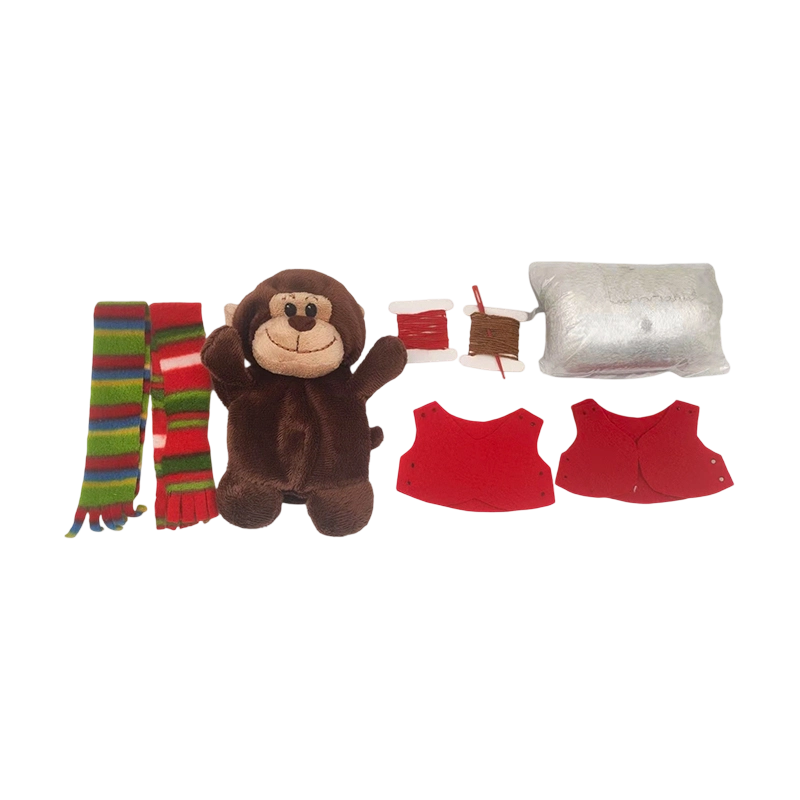
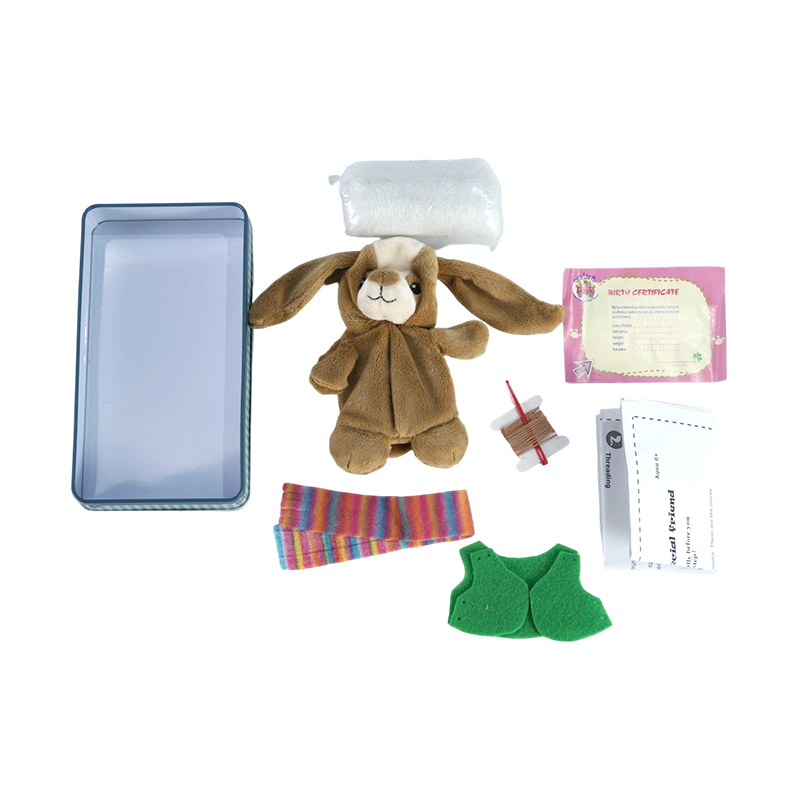 Brown Long-Ear Puppy DIY Plush Sewing KitBrown long-ear puppy sewing kit with vest, scarf, stuffing, needle, and thread; shares construction across boys' and girls' plush ranges.View Product →
Panel count and seam curvature set sewing time and how the stuffed animal sits. The fill specification, together with seam allowance, decides whether fibre stays inside the shell. And small-parts rules set the age grade: kits rated 36 months and under cannot contain a needle at all, so the practical commercial floor for a sewing kit is an older grade with a justified sharp point.
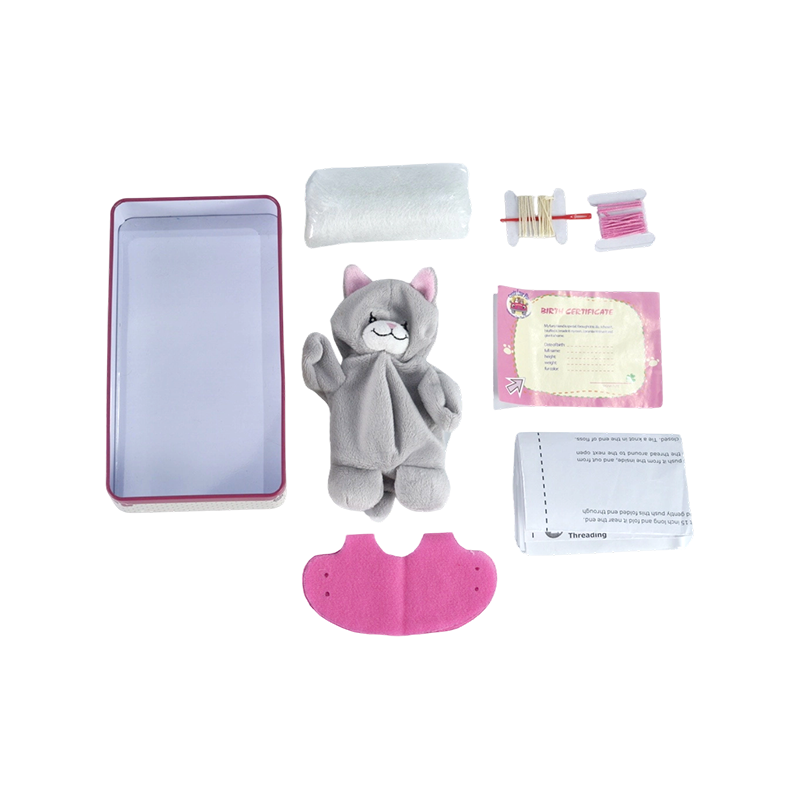
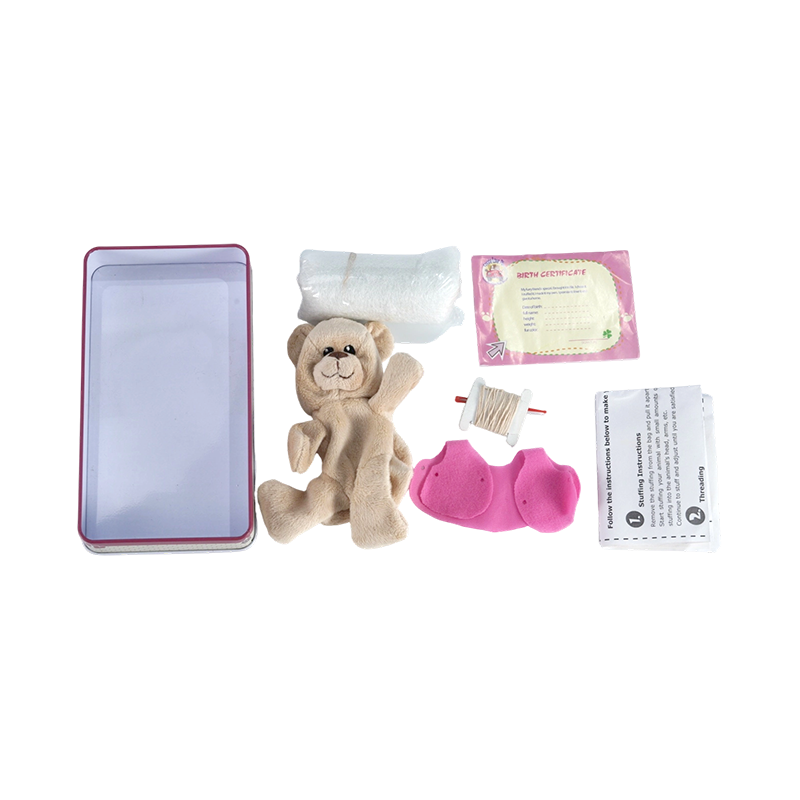 DIY Plush Bear Stuffed Animal Making KitAll-in-one plush bear kit with shell, stuffing, needle, thread, stickers, and birth card for supervised children aged 5–10.View Product →
Most buyers ask for an MOQ before they ask for a bill of materials. That order is backwards: MOQ is an output, determined by what makes tooling, testing, packaging printing and line changeover viable. Change the inputs and the MOQ moves.
| Cost driver | What changes it | Direction of impact |
|---|---|---|
| Shell construction | Panel count, seam curvature, appliqué and embroidery density | More panels and hand-set details raise unit cost and MOQ |
| Fabric | Short-pile plush, corduroy, recycled PET pile, brushed cotton | Specialty or recycled fabric raises cost and lengthens lead time |
| Kit components | Needle type, thread length, felt count, fill weight | Each extra component adds piece counting and packing labour |
| Instructions | Number of languages, page count, colour printing | Multi-language booklets are the most underestimated line |
| Packaging | Poly bag, window box, blister card, retail-ready tray | Printed packaging is normally the largest fixed tooling item |
| Testing and documentation | Age grade, destination market, number of reports required | Raises upfront testing cost, not unit cost |
| Order quantity | First order band versus reorder band | Reorders reuse tooling, so unit cost falls |
Tooling is a one-time cost. Embroidery files, print plates, dies and pattern grading should be amortised against the first order and effectively free on reorders, so negotiate it that way before the first PO rather than after the artwork is approved.
Treat any MOQ figure as market-specific. Factories running more than 200 staff and capacity in the region of 1.5 million sets a year tend to have more flexibility in how an order is phased than in the absolute ceiling they will accept.
DIY kits fail inspection for unglamorous reasons. Character design is rarely the problem; components, labelling and instructions usually are.
A kit sold for 36 months and under cannot include a needle or any sharp functional point, which removes the sewing activity entirely. Move to 6+ or 8+ and the needle becomes defensible - provided the sharp point is a genuine functional necessity, is recorded in the technical file, and the warning sits on the pack. Fixing the age grade after sample approval is the most expensive sequencing error in this category.
Loose fibre, a safety eye that works free and a needle that snaps all fail the same test. Enclosed fill bags, tightly woven shells and embroidered features for younger grades remove most of that risk. Expect EN 71 and REACH documentation for the EU, ASTM F963 and CPSIA for the US, and the ST mark framework for Japan. Recent EU toy safety regulation upgrades push more of the burden onto the manufacturer's technical file, so an older age grade only helps if the paperwork keeps pace.
An OEM program of this type normally runs through eight stages, with manufacturing experience of more than 23 years sitting behind the pattern and tooling work.
Two stages deserve extra attention. Colour matching should be locked with approved lab dips and checked under controlled light, because plush pile reads differently in a warehouse, a store and a phone photograph. The pre-production sample is also the last cheap moment to catch a problem: a fix there costs days, while the same fix after loading costs a rework line, retesting and a missed retail window.
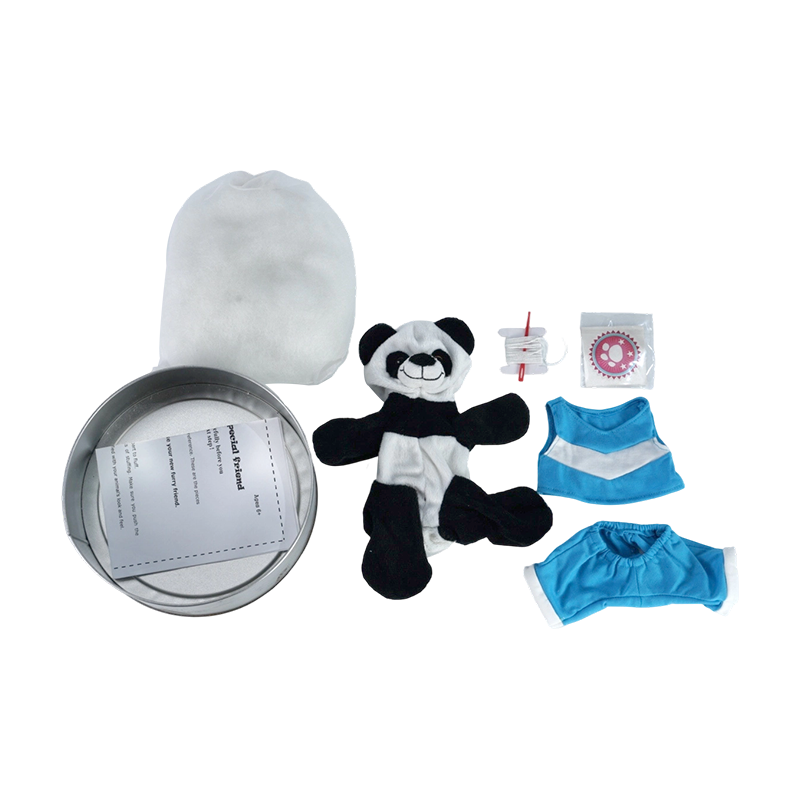 Sporty Panda DIY Plush Toy Making Craft KitSporty panda sewing kit with athletic outfit, transfer stickers, and stuffing; color matching and pre-production samples matter before ordering.View Product →
Get written answers to these nine points before the purchase order goes out.
It depends on how much of the kit is new. Reusing an existing shell with new artwork and packaging supports far smaller runs than a new pattern, new fabric and a printed window box. Ask for MOQ quoted per configuration, plus the reorder figure.
Usually, provided the shells share construction, fabric and fill, and the packaging is not character-specific. Mixed-character orders are common in gift and education channels because they spread development cost across a wider range.
Settle it in the development agreement before tooling starts. Confirm artwork, embroidery files and patterns separately, and agree what happens to the tooling if the program pauses.
Sampling, revisions, testing and pre-production approval consume the time; cutting and sewing are quick once the specification is frozen. Build the testing window into the schedule instead of treating it as an afterthought.
A DIY animal kit for boys sells on two things at once: a character a child wants to finish, and a kit that passes inspection in the destination market. Both are specification problems, and both are cheaper to solve in the pattern room than at the port.
If you are planning a boys' kit line for Europe, the US, Japan or Southeast Asia, bring the target age grade, destination market, character direction and packaging format to the first conversation. Those four inputs determine the pattern, the components, the testing scope and the MOQ - and they determine them before a single sample is cut.
Address

Your project will meet a
right solution with Golden Sun



 English
 日本語
日本語 Français
 русский
 Español